

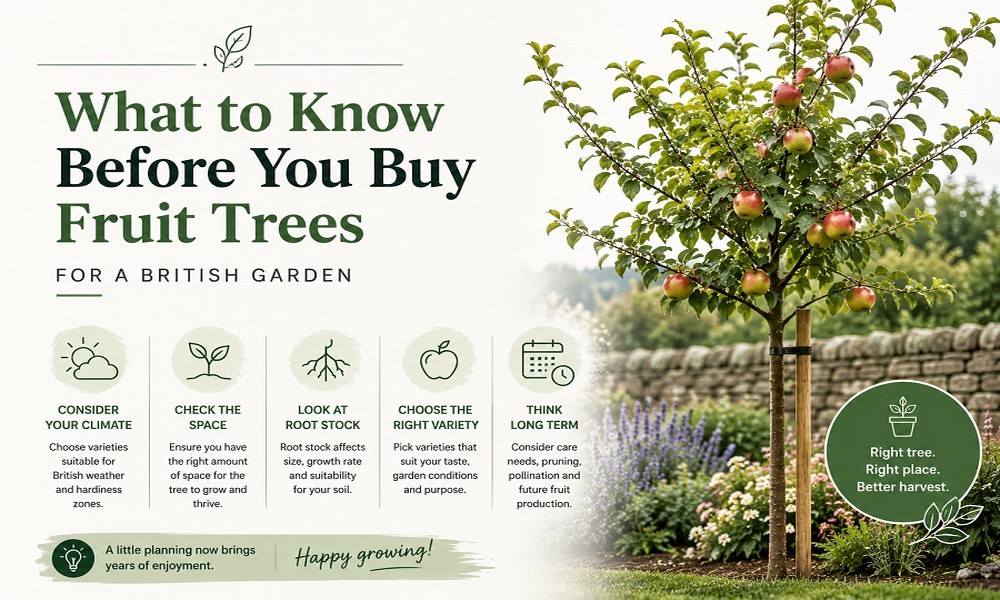
A British garden can be generous, awkward, sheltered, windswept, damp in winter, dry by late July, or all of those things in one season. That is why choosing a fruit tree is not simply a matter of picking a familiar variety and hoping it settles in. A tree becomes part of the garden’s structure, and the best choices are made with the same care as a new hedge, path, or seating area.
The most successful home growers usually start by looking honestly at the place they have. They notice where morning sun lands, where cold air collects, how quickly the soil dries after rain, and how much room they can give a tree once it is mature. Those observations are more useful than a long wish list of varieties, because they turn a permanent planting decision into a practical one.
For gardeners preparing to buy fruit trees, the fruit tree specialists at Fruit-Trees suggest starting with site conditions before variety names. A tree that suits the soil, space, rootstock, and pollination setting is far more likely to establish cleanly, crop consistently, and remain enjoyable to manage than one chosen only for a favourite fruit or an attractive catalogue description.
This guide looks at the decisions that matter before ordering. It is written for ordinary British gardens rather than show orchards, with attention to small lawns, mixed borders, patios, clay soils, late frosts, and the everyday work of keeping a young tree healthy through its first few years.
The article also treats fruit trees as part of ordinary garden life rather than as specialist orchard equipment. That distinction matters. Most households need a tree that can cope with imperfect weather, limited time, and a space shared with other planting. The strongest choices are not always the rarest or most dramatic; they are the trees that remain healthy, accessible, and useful after the initial excitement has passed.
Match the Tree to the Garden You Actually Have
It is tempting to imagine the garden you would like to have in five years and choose a tree for that picture. The better starting point is the garden that exists now. A narrow side return, a square lawn, a north-facing boundary, or a sheltered courtyard can all support fruit, but each asks for a different form of tree. Thinking in terms of real conditions prevents disappointment later.
Space is the first practical limit. Many gardeners underestimate mature spread because a young tree arrives looking modest and manageable. Rootstock, training method, and pruning all influence final size, yet the tree still needs air around it, room for light to reach the branches, and access for picking. A tree that is squeezed into a corner can become harder to prune, less productive, and more vulnerable to disease.
The best match is not always the largest or most vigorous option. A cordon, stepover, fan, dwarf tree, or semi-dwarf bush can give more useful fruit in a small garden than a traditional orchard tree that quickly overwhelms its position. Gardeners who begin with shape and size often find variety choice becomes clearer rather than more complicated.
A useful test is to imagine the tree during the least convenient week of the year, not during the most inspiring one. If it will still be easy to reach, water, prune, and live around during a wet school week or a busy work period, the choice is probably realistic. If it needs constant ladder work, blocks a gate, or depends on a corner that is already crowded, it may become a source of frustration. This kind of practical imagining is especially valuable in British gardens because space is often shared between several uses. A tree has to belong to the daily garden, not just to the plan made before planting.
This is why measuring is worth doing before any order is placed. A rough sketch with mature spread, path width, and shade direction marked on it can prevent mistakes that are hard to correct once roots are established.
Read the Site Before Choosing a Variety
Sunlight matters because fruit trees need energy to flower, set fruit, ripen wood, and develop flavour. In many British gardens, the difference between full sun and partial shade is not a neat line on a plan. A wall, shed, fence, or neighbouring tree may change the light pattern across the day. Watching the site in morning and afternoon is a simple but useful check.
Soil is just as important. Heavy clay can be fertile, but it needs careful preparation so winter water does not sit around the roots. Light sandy soil drains quickly and may warm early, yet it can run short of moisture during dry spells. Most fruit trees prefer soil that holds enough moisture without becoming stagnant, so improvement should aim for structure rather than quick cosmetic change.
Exposure deserves attention in open or coastal areas. Wind can loosen young trees, dry out blossom, damage soft growth, and make pollinating insects less active. A tree does not need a completely still site, but it does need enough shelter to establish. Where wind is a regular issue, staking, a protective hedge, or a trained form against a wall can make the difference between survival and steady growth.
The site should also be judged across seasons, because a position that looks promising in May may behave very differently in November. Winter wet, low sun, and leafless shelter can reveal problems that summer growth hides. A place close to a fence might be warm and bright in June but shaded for much of the dormant season. Another position may seem exposed until nearby shrubs fill out and soften the wind. Gardeners who take a little time to read these changes usually make better choices, because the tree is being chosen for a living site rather than a single moment of inspection.
If the site is uncertain, it is better to choose a forgiving fruit and a manageable form than to rely on perfect aftercare. Good selection reduces pressure on the gardener from the first season.
Think About Pollination Before the Order
Pollination is one of the most overlooked parts of choosing fruit trees. Some varieties are self fertile, some need a compatible partner, and others crop better when another suitable tree is nearby even if they can fruit alone. In towns and villages, neighbouring gardens may help, but relying on an unknown tree over the fence is not always a sound plan.
The question is not only whether another tree exists, but whether it flowers at the right time. Apple, pear, cherry, plum, and other fruit trees are grouped by flowering period, and compatibility depends on overlap. A beautiful variety that flowers too early or too late for its partner can still struggle to set a reliable crop. This is especially relevant in colder districts where spring is unpredictable.
Gardeners with room for one tree should pay close attention to self fertile options, family trees, or varieties known for reliable cropping. Gardeners with more space can plan a small group that supports itself across the season. Either way, pollination should be considered before the tree is ordered, not after blossom appears and fruit fails to follow.
This is also the stage to be honest about neighbouring gardens. In many UK streets, nearby apples, pears, and ornamental crab apples can help with pollination, but they should be treated as a bonus rather than a guarantee. Trees are removed, pruned hard, or replaced, and the gardener may never know their flowering group. Where cropping matters, planned compatibility is more dependable. Even when a self fertile variety is chosen, a garden rich in blossom and insect activity will often perform better than one with little spring life. Pollination planning is therefore both botanical and practical.
Pollination notes should be kept with the tree label or garden records. They are useful later if another tree is added, replaced, or moved, and they help maintain the garden as a planned system.
Give Rootstock as Much Attention as Variety
Variety names often get the attention because they describe flavour, appearance, season, and kitchen use. Rootstock quietly controls much of the tree’s behaviour. It affects vigour, mature size, cropping speed, suitability for containers, tolerance of soil conditions, and the amount of pruning needed. A good variety on the wrong rootstock can become the wrong tree for the garden.
In a small garden, rootstock is often the difference between an enjoyable tree and a long-running maintenance problem. A compact apple on a restrained rootstock may suit a border or lawn edge, while a vigorous form needs more space and may take longer to settle into cropping. Pears, plums, cherries, and other fruits have their own rootstock considerations, so it is worth reading beyond the headline variety description.
The aim is not always to choose the smallest possible tree. Very dwarfing options can need more careful watering, feeding, support, and weed control. A slightly stronger rootstock may be more forgiving in open ground. The best choice is the one that fits the site, the gardener’s confidence, and the amount of long-term care the tree will receive.
Rootstock notes can look technical at first, but they are simply a way of predicting how the tree will behave. They help the gardener understand whether the tree is likely to need a permanent stake, whether it will suit a pot, how soon it may crop, and how much room it will claim. Reading this information carefully is one of the simplest ways to avoid a mismatch. It also helps compare two apparently similar trees. The same apple variety, for example, can behave quite differently depending on the rootstock beneath it, so the hidden lower part of the tree deserves real attention.
Rootstock also affects how soon the tree may need support removed or adjusted. Checking this detail stops stakes and ties from being forgotten, which can otherwise mark or restrict the trunk.
Plan the First Two Years, Not Just Planting Day
Planting day is important, but the first two years decide whether a tree establishes with strength. The roots need contact with improved but not over-enriched soil, the graft union must sit above soil level, and the tree should be firm without being planted too deeply. A careful start gives the tree the best chance to make new roots before it is asked to crop heavily.
Watering is often underestimated in Britain because the climate feels wet. New trees can still dry out quickly, especially in spring winds or during warm spells on light soils. A slow soak at the root zone is more useful than frequent shallow watering. Mulch can help conserve moisture, but it should be kept clear of the trunk to avoid rot and pest problems.
Early pruning should be calm and purposeful. The goal is to build a framework, remove damaged or badly placed growth, and encourage balanced shape. Over-pruning can delay establishment, while neglect can leave weak angles and crowded branches. A little attention each year is usually better than a drastic correction once the tree has become tangled.
The first two years are also when expectations should be kept steady. It is better to see strong leaf growth, a healthy root system, and a balanced framework than to chase a heavy early harvest. If a young tree flowers and sets fruit, the gardener may need to thin it or remove some fruit to protect the developing branches. That can feel severe, but it is a sign of long-term thinking. A tree that is allowed to establish properly will usually be easier to manage and more productive later than one pushed hard before it has built strength.
A young tree that looks quiet above ground may be doing important work below it. That is why steady watering, weed control, and patience matter even when there is not much visible drama.
Build a Home Orchard That Feels Part of the Garden
A fruit tree should not feel like a separate project that competes with the rest of the garden. It can frame a view, mark a boundary, soften a lawn, feed pollinators, shade a seat, or give height to an edible border. When it is placed with the whole garden in mind, the tree earns its place before the first full crop arrives.
This broader view also helps with patience. Fruit trees reward steady care rather than urgency. Blossom, leaf, branch shape, autumn colour, and winter structure all contribute to the garden while the tree matures. Crops improve as the tree settles, and the gardener learns how it behaves in that particular soil and climate.
The best pre-order decision is therefore practical and imaginative at the same time. Choose for the real garden, the real maintenance routine, and the real way the fruit will be used. A tree chosen on those terms is more likely to become a permanent pleasure rather than a hopeful experiment that never quite fits.
The most satisfying home orchards often grow gradually. One well-chosen tree teaches the gardener about their soil, weather, pests, pollinators, and household fruit preferences. A second tree can then be chosen with more confidence. This gradual approach suits ordinary gardens because it avoids overplanting and leaves room for adjustment. It also keeps the project enjoyable. Instead of trying to create a complete orchard at once, the gardener builds a productive garden layer by layer, with each tree earning its place and improving the decisions that follow.
Over time, this approach creates a garden that feels intentional. Each tree has a role, enough space, and a care routine that makes sense, so the orchard grows as part of the whole design.
