

Marine berthing and ship-to-ship operations expose vessel hulls to impact forces that, without adequate fendering, cause structural damage to both the vessel and the berth infrastructure. Pneumatic fenders have become the dominant fendering solution for large vessels, offshore operations, and ship-to-ship transfers because the compressed air chamber within the fender absorbs kinetic energy through compression, distributing the impact load across a large contact area and limiting the pressure transmitted to the hull. Understanding the types of pneumatic rubber fenders, the specifications, and how large ship fenders are selected for specific applications helps port operators, shipping companies, and offshore contractors make informed procurement decisions.
What is a pneumatic fender?
A pneumatic fender is an air-filled rubber fender whose energy absorption capability comes from the compression of the internal air volume under impact load. Unlike foam-filled fenders or solid rubber fenders, which absorb energy through material deformation, the floating pneumatic rubber fender stores absorbed energy as increased air pressure within the chamber, which produces a reaction force that grows progressively with deflection rather than spiking at initial contact.
The principal advantages of pneumatic rubber fenders over alternative fender types include:
- High energy absorption at low reaction force: the air compression mechanism delivers exceptional energy-to-reaction-force ratios, which limits the compressive load transmitted to the vessel hull and berth structure
- Floating capability: floating pneumatic rubber fenders maintain the position at the waterline regardless of tidal variation, ensuring consistent contact geometry between the fender and the vessel hull across the full tidal range
- Large contact area: pneumatic fenders deform under load to present a large surface area against the hull, distributing the reaction force across a wide zone and reducing point loading on hull plating
- Self-righting: a fender pneumatic that is temporarily submerged or displaced by wave action returns to the correct orientation when conditions normalise, without manual intervention
What are sling type pneumatic fenders?
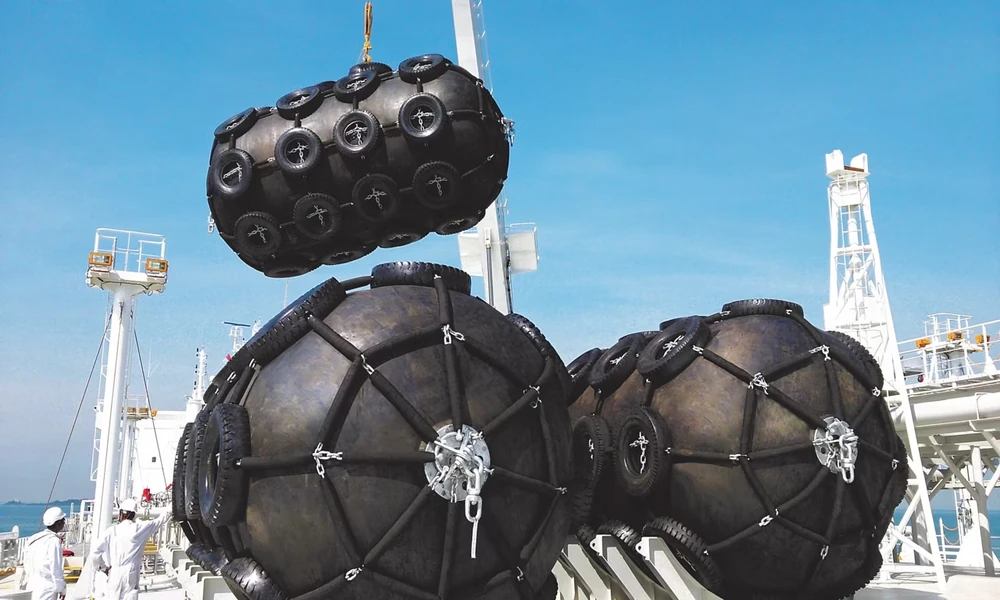
SLING TYPE pneumatic fenders are pneumatic rubber fenders suspended in a net or chain sling system that distributes the applied load across the fender body and protects the rubber surface from abrasion against the vessel hull and the quay structure. The sling system also provides the connection point for the mooring lines or chains that secure the fender in position relative to the berth or the larger vessel in a ship-to-ship operation.
Sling type pneumatic fenders are specified for applications including:
- Ship-to-ship transfer operations where the fender must remain positioned between two moving vessels in open water conditions with wave action and relative vessel motion
- Offshore floating production storage and offloading (FPSO) berthing where the fender needs to absorb the significant kinetic energy of a large tanker approaching in open sea conditions
- Large vessel berths where the reaction force and energy absorption requirements exceed the capability of standard quay-mounted fender systems
What is a pneumatic fender with CTN?
A pneumatic fender with CTN (chain-tyre-net) is a pneumatic fender fitted with a protective outer layer of tyres held in a chain net framework. The tyre and chain net assembly protects the rubber fender body from abrasion and puncture damage in applications where the fender makes repeated contact with rough hull plating, rusted surfaces, or the chain and rope gear of working vessels.
The CTN arrangement also increases the effective contact area of the pneumatic fender, distributing the reaction force across the tyre contact surface rather than concentrating it on the rubber fender skin. In high-abrasion environments such as ship repair yards, bulk carrier terminals, and RoRo ramps, the CTN specification significantly extends fender service life compared to bare pneumatic rubber fenders.
What is a hydro pneumatic fender?
A hydro pneumatic fender is a fendering system that uses a mixture of compressed air and water within the fender chamber to modify the energy absorption and reaction force characteristics relative to a pure air-filled pneumatic fender. The water component increases the effective stiffness of the fender at low deflection while the air component provides the progressive reaction force characteristic that limits peak load at high deflection. Hydro pneumatic systems are used in applications where the reaction force profile of a standard pneumatic fender needs to be adjusted for specific vessel approach velocity and mass combinations.
How is fender offshore specification determined?
Fender offshore specification for any application begins with the calculation of the kinetic energy that the fendering system must absorb during vessel approach. This calculation requires the vessel displacement (mass), the approach velocity perpendicular to the berth, and the configuration factor for the approach geometry. The selected fender must have an energy absorption capacity that exceeds the calculated kinetic energy at the maximum allowable deflection, with an appropriate safety margin.
The reaction force at maximum deflection must also be within the limits that the vessel hull, the berth structure, and the mooring system can safely accommodate. Matching energy absorption to reaction force for the specific vessel and berth combination is the core engineering task in large ship fenders selection.
Conclusion
fPneumatic fenders, floating pneumatic rubber fenders, sling type pneumatic fenders, and hydro pneumatic fenders serve the full range of marine fendering requirements from harbour berths and ship-to-ship operations to offshore floating platform berthing. Correct specification against the calculated kinetic energy and allowable reaction force for each application is the foundation of effective fender selection.
Pneumatic rubber fenders are widely used for ship-to-ship transfer, berthing, and offshore applications across ports, shipyards, and maritime operations. Available options include large ship fenders, CTN and sling-type pneumatic fenders, complete pneumatic fender systems, and offshore fendering solutions, with specifications and certification documentation suited to professional marine procurement. For fixed berth applications, buyers can also explore arch rubber fenders for reliable and durable fendering requirements.
