

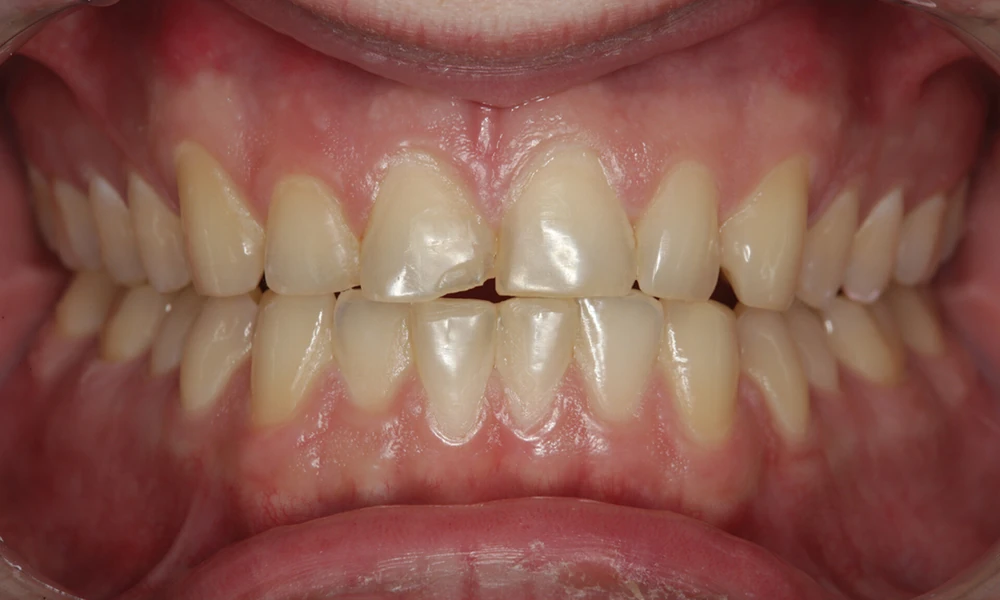
You notice it in the mirror before you feel it. A tiny chip on a front filling, a rough edge on a veneer, a line near the bonding that was not there before. Because it is a front tooth, it does not feel minor. You see it when you talk, smile, and eat, and that alone can make a small dental problem feel much bigger. For patients seeking cosmetic dental services in Bridgeport CT, even a minor change in a front tooth can feel especially noticeable.
In many cases, a damaged restoration on one front tooth can be repaired instead of fully replaced. The answer depends on how much of the material failed, whether decay is present underneath, how well the restoration still seals the tooth, and whether the tooth itself is strong enough to keep. A small chip, stain line, worn edge, or localized defect often points toward repair. Deep decay, a loose restoration, a major fracture, or repeated failure usually points toward replacement.
Small defects in a front tooth restoration often respond well to repair
A front tooth restoration can mean composite bonding, a filling, a veneer, or a crown. Each one can fail in different ways, but the same basic question applies. Is the problem limited, or has the whole restoration broken down?
If the issue is limited, repair is often the more conservative choice. That matters for a front tooth because every time a restoration is removed and remade, some healthy tooth structure may be lost. Repair can preserve more of your natural tooth, shorten treatment time, and lower cost.
The dental profession has moved more toward repair when it makes sense. The American Dental Association reported that many dentists favor repair for defective restorations rather than automatic replacement, based on an ACE panel report on repairing defective restorations. That reflects a simple truth. Not every defect means the whole restoration has failed.
You might be dealing with a bonded front tooth that chipped at the corner after biting into a crusty sandwich. If the bond to the tooth is still sound and there is no decay, your dentist may be able to smooth, recontour, and add new material to the damaged spot. If a veneer has a tiny edge chip but remains firmly attached and the tooth underneath is healthy, a localized repair may be possible. When the problem stays small, the fix can stay small too.
Replacement becomes more likely when the tooth or seal is no longer sound
A repair only works when the remaining restoration is stable. If bacteria have leaked under the material and caused decay, patching the surface does not solve the real problem. The same is true when a crown is loose, a veneer has a large crack across the visible surface, or a filling has broken in a way that leaves too little support.
This is where front tooth problems get frustrating. A tooth can look like it has a simple cosmetic flaw, but the issue may run deeper. A dark line at the edge might be surface staining, or it might be leakage. A chipped corner might be a small polish-and-bond repair, or it might show that the bite forces on that tooth are too heavy for the current material.
Material matters too. The National Institute of Dental and Craniofacial Research explains that dental fillings and restorative materials vary in durability, appearance, and best use, and no single material fits every situation. You can review the basics on dental fillings and restorative options and see broader details in this NIDCR guide to dental materials. For one visible front tooth, your dentist has to weigh strength, color match, bonding quality, and how much natural tooth remains.
That is why single front tooth restoration repair is never just about covering a flaw. It is about whether the repaired area will hold up and still look natural in a part of your smile that gets constant attention.
Repair versus replacement depends on the defect, the tooth, and the material
Some people assume replacement is always better because it sounds more complete. Others want repair at all costs because they want to avoid expense or numbing. Both reactions are understandable, and both can miss the middle ground. The best choice is the one that fixes the actual cause of the problem without removing more tooth than necessary.
| Situation | Repair May Be Appropriate | Replacement May Be Better |
|---|---|---|
| Small chip on composite bonding | Yes, if the bond is secure and there is no decay | No, unless the chip reflects wider failure |
| Staining at the edge of a front filling | Yes, if it is surface staining or a minor margin defect | Yes, if staining signals leakage or decay underneath |
| Veneer with a tiny edge flaw | Often, if the veneer is firmly attached and the defect is localized | Likely, if there is a crack through the veneer or poor fit |
| Crown on a front tooth with a loose margin | Rarely, since the seal may already be compromised | Usually, especially if the crown is loose or decay is present |
| Repeated repairs on the same tooth | Sometimes, if each issue has been minor | Often, if the restoration keeps failing |
This is the practical side of repairing a front tooth restoration. The less tooth structure involved, the more attractive repair becomes. The more the defect affects fit, strength, or decay risk, the more replacement makes sense.
Three steps help you make a smart decision quickly
1. Get the tooth checked before it gets worse. Front tooth restorations rarely improve on their own. A tiny rough spot can become a larger chip, and a small leak can turn into decay. Early visits create more room for a conservative fix.
2. Ask what failed, not just what it costs. If you hear repair or replacement, ask why. Was it the material, the bite, the seal, the color match, or decay under the restoration? That answer tells you whether a smaller fix is realistic or whether it would only delay a bigger problem.
3. Choose a plan that protects both appearance and tooth structure. A front tooth sits in the center of your smile, but it still has to function. The right cosmetic dentist or family and cosmetic dentist will weigh shade, shape, strength, and long term support instead of treating it as a quick patch.
A careful repair can be the right answer for one visible tooth
If the damage is small and the tooth is healthy, repair can save time, preserve enamel, and keep a good restoration working longer. If the seal has failed, the material is unstable, or decay has started, replacement is usually the safer path. Both options can be good care when they match the condition of the tooth.
You do not need to guess by looking in the mirror. If one front tooth restoration has chipped, stained, or started to feel rough, schedule an evaluation with a family and cosmetic dentist and get a plan based on what is actually happening under the surface.
