

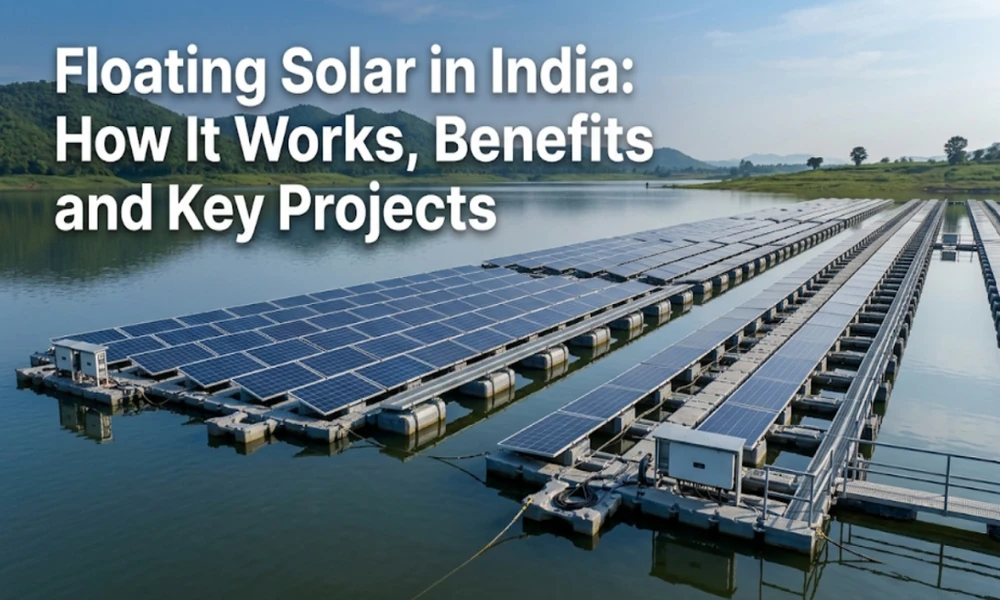
Land requirements for large-scale solar power generation can be hard to fulfill in countries such as India, where land is used for agriculture and industry. There is another type of technology that is available, known as floating solar panels. This uses water bodies like reservoirs and lakes to generate electricity using solar panels.
There have been many floating solar projects in various parts of India. With many other projects planned to come up in the future, this technology may become very crucial for renewable energy production in India.
What Is Floating Solar Power?
Floating solar panels operate almost in the same way as ordinary solar panels used in solar plants. The only difference is that solar panels are mounted on a floating platform instead of fixed ground structures.
The floating platforms are normally made of robust materials such as high-density polyethylene. These platforms are connected in rows using anchoring systems to ensure that they remain in position even as the water level changes. The electricity produced is carried to the solar inverters using cables, where it is then converted for distribution in the network.
Nevertheless, mounting solar panels in the water requires a lot of planning. With constant exposure to moisture and humidity, the equipment should be able to cope with such conditions. Getting the solar panels from an experienced manufacturer of panels will help developers in choosing appropriate outdoor panels.
Why Floating Solar Energy Is Attracting Interest in India?
1. It utilizes the available water surfaces
It doesn’t require the use of a great deal of land. The reservoirs or lakes suitable for such an installation may serve as an alternative to land that may be needed for agricultural use.
2. Solar panels may be more efficient in a cool environment
The increased temperature may make solar panels less effective in generating energy. But the water around the installation may ensure the cool environment necessary for the panels.
3. It can assist in conserving water
As floating systems cover certain areas of the water surface, they create shade over these surfaces, thereby decreasing the amount of water evaporated from the surface. It may become helpful in regions where water conservation is important. However, it is also necessary to take into consideration the climate in the area.
4. It may be combined with other energy facilities
Reservoirs already connected to hydroelectric facilities and other infrastructure may also become useful in such installations.
What Challenges Should Developers Consider?
Despite its advantages, floating solar is not suitable for every water body. Strong winds, waves, and changing water levels can put pressure on the floating structure. The anchoring system must be designed according to local conditions, while electrical components need appropriate protection against moisture.
Maintenance also requires more planning than a typical ground mounted installation. Reaching panels for cleaning, inspecting cables, and repairing equipment can be difficult when the system is located far from the shore.
Developers must also consider fishing, boating, water use, and the possible effects on aquatic life before selecting a site. A proper site assessment can help identify these concerns early.
What Would Be the Future of Floating Solar in India?
The success of floating solar in the future would depend on the cost of projects, locations, grid integration, and the ability of developers to handle technological challenges. The combination of solar power with energy storage would also assist in addressing the gap between generation and consumption of electricity.
The newer types of panels, such as HJT modules, could be evaluated in case of projects that require consideration of temperature behavior and efficiency of modules. Yet, the final decision should be made based on project conditions.
With India moving ahead in developing renewable energy sources, floating solar power generation can become one more way of generating clean power.
Conclusion
The floating solar technology may play a vital role in assisting India in producing more clean energy without exerting any further strain on land-based resources. With the growing expansion of these initiatives, it will be essential to select solar panels that can withstand the presence of water, changes in weather conditions, and the rigors of being outdoors. Being one of the leading providers of solar modules in India with more than 25.8 GW of manufacturing capacity, Waaree is experienced in manufacturing and designing modules of various solar technologies.
