

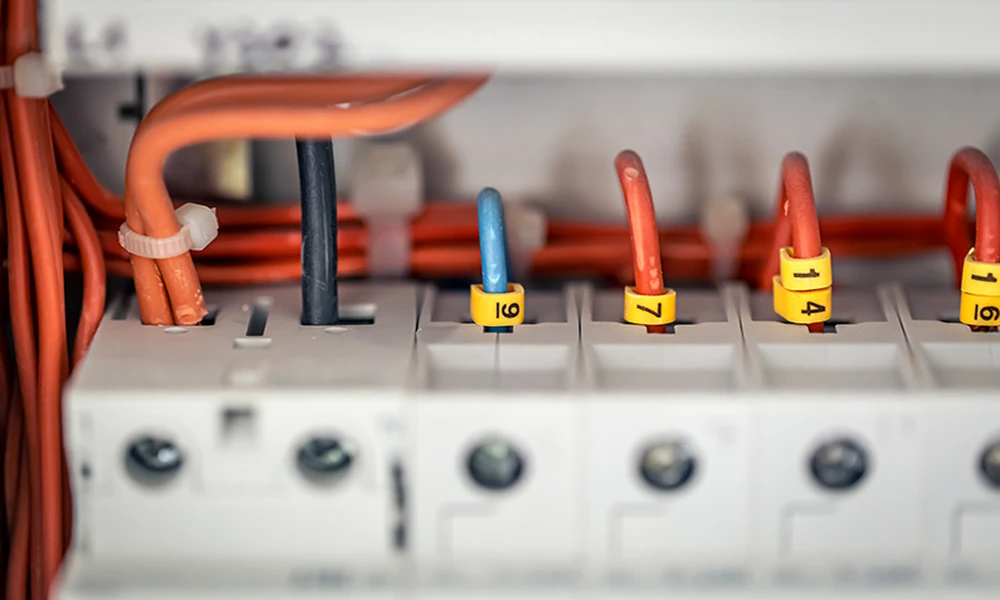
A fuse does its most important work in a few thousandths of a second, melting before a fault current can burn a cable or wreck a motor. The part around it gets far less attention, yet it is just as important. Fuse holders keep the fuse link in firm contact with the circuit, shield people from live metal and let a technician swap a blown fuse safely. When the holder fails, a perfectly good fuse can still end up overheating, arcing or clearing a fault badly.
Picture a maintenance technician on a factory floor near the end of a long shift. A conveyor has stopped, the panel door stands open, and a row of identical modules sits on the DIN rail. Good fuse holders make the next five minutes simple: an indicator shows which fuse blew, the carrier opens without exposing live parts, and the replacement fits only one way. Poor ones turn the same task into a gamble with a live panel.
What Does a Fuse Holder Do Beyond Simply Holding the Fuse?
A holder carries current, so its contacts must grip the fuse ends with steady pressure and low resistance. It insulates, so the body must withstand the system voltage, heat from the fuse and the occasional arc. Many industrial designs also double as disconnectors, letting the user open the carrier to isolate a circuit while it carries no load. Experienced fuse holder manufacturers treat each of these duties as a separate design requirement and test for all of them.
Physical protection matters as much. Modern panel fuse holders are usually finger-safe, with shrouded terminals rated IP20 so a hand cannot touch live metal through the openings. Some include a blown-fuse indicator lamp, and others accept fuse links with a striker pin that trips an auxiliary switch to signal a fault to a control room. Those small features save real time during a breakdown, when every minute of a stopped line costs production and patience runs short. A clear label on each holder showing the circuit and fuse rating helps just as much.
Which Types of Fuse Holders Suit Panels, Circuit Boards and Cables?
The right style depends on where the fuse lives, and electrical components manufacturers generally group holders into a few families:
- Modular DIN-rail holders: the common choice in control panels, taking cylindrical fuse links such as the 10 x 38 mm size.
- NH fuse bases: open or covered bases for blade-type industrial fuses used in distribution boards and motor feeders.
- PCB fuse clips and holders: compact parts soldered onto circuit boards to carry miniature fuses inside equipment.
- Panel-mount holders: screw-cap housings fitted through the front of an instrument so users can change the fuse from outside.
- Inline holders: cable-mounted housing used in vehicles, solar strings and portable equipment.
Each family solves a different access problem. A PCB clip suits a fuse that should only be replaced during servicing, while a panel-mount holder suits equipment where the owner may change it. Deciding early avoids awkward redesigns later. A fuse holder supplier with a broad range can often offer several styles that accept the same fuse link, which helps when one product needs both internal and user-accessible protection.
How Does IEC 60269 Shape Fuse and Holder Ratings
IEC 60269 works like a family rulebook for low-voltage fuses, with separate chapters for different users and jobs. Part 1 sets general requirements, Part 2 covers fuses handled by authorized persons in industry, Part 3 covers fuses that untrained people may handle, mainly in homes, Part 4 deals with fuses that protect semiconductors, and Part 6 covers solar photovoltaic systems. Fuse links also carry utilization categories: gG for general full-range protection of cables and aM for partial-range protection of motor circuits. Miniature fuses follow a different series, IEC 60127, so fuse holder manufacturers state which standard each product meets.
The holder must match the fuse link in size, voltage, and power dissipation. Every fuse link heats up while carrying current, and each holder has a maximum power acceptance it can handle without overheating. Pack many holders side by side in a warm cabinet and each one can safely carry less current, so ask the fuse holder supplier for derating data at the expected cabinet temperature. In DC solar circuits, the voltage rating needs extra care, since direct current never passes through zero, so an arc resists going out.
Why Can a Holder Overheat Even When the Fuse Rating Looks Right
Most holder failures trace back to contact problems. A clip that has lost its spring tension, a terminal screw left under-tightened, or a fuse link with slightly different end caps can all raise contact resistance. That resistance turns into heat at the joint, discoloring the body and making the fuse blow early. Nuisance blowing then tempts people to fit a larger fuse, which defeats protection. Pairing fuse links and holders that electrical components manufacturers list as compatible in their catalogues avoids most of these mismatches.
Vibration, humidity, and dust add to the strain in factories, pumping stations, and rooftop solar plants. Copper alloy contacts with tin- or silver-plating resist corrosion better than bare metal, and a flame-retardant body holds its shape under heat. Careful fuse holder manufacturers print tightening torque values on the product or its data sheet, and those numbers deserve the same respect as the fuse rating itself.
At What Point Should a Fuse Holder Be Replaced?
Replace a fuse holder as soon as it shows discoloration, cracks, weakened contacts, or a carrier that no longer closes firmly. Periodic thermal imaging of a loaded panel catches hot holders before they reach that stage. Keeping a few spare fuse holders of exactly the type already installed means a damaged one can be swapped quickly, without improvising a mismatched part.
