

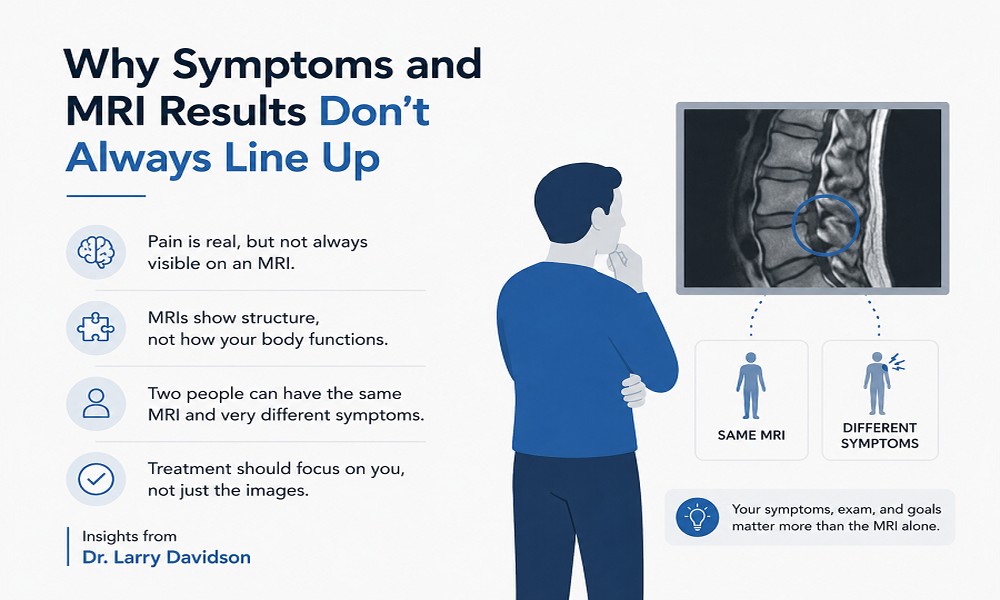
It is common for patients to look at MRI results as a definitive explanation for their pain. Seeing a disc bulge or degeneration on a report can feel like a clear answer, especially when symptoms have been persistent or difficult to understand. At the same time, spine care does not rely on imaging alone. Dr. Larry Davidson, a board-certified neurosurgeon with fellowship training in complex spinal surgery, has seen how patients sometimes assume that every finding on an MRI must be the source of their discomfort, even when the connection is not that straightforward.
Matching symptoms with imaging requires a more careful approach. While MRI scans provide detailed views of spinal structures, they do not capture how pain is experienced or how the body functions. Understanding how these pieces fit together helps prevent misinterpretation and supports more accurate decision-making.
Why MRI Findings Can Be Misleading on Their Own
MRI scans are highly sensitive, meaning they often detect changes in the spine that may or may not be clinically significant. Disc degeneration, bulging discs and other structural variations are commonly seen, even in individuals who do not report any pain.
Because of this, an MRI can show multiple abnormalities while only one, or none, is actually responsible for the symptoms. Patients may focus on what appears most noticeable in the report, but that finding may not correspond to where or how the pain is experienced. This disconnect highlights why imaging must be interpreted in context. Without considering the patient’s symptoms, MRI findings alone can lead to incomplete or inaccurate conclusions.
Understanding Where Symptoms Originate
Pain and neurological symptoms often follow specific patterns that reflect how nerves function. For example, pain that travels down the leg typically follows a nerve pathway originating in the lower spine, while symptoms in the arm may relate to the cervical region.
These patterns provide important clues about where the issue may be located. When evaluating MRI findings, physicians look for abnormalities that align with these patterns. A disc herniation pressing on a nerve root, for instance, may explain radiating pain that follows a consistent path.
If the location of symptoms does not match the imaging findings, it raises questions about whether the visible abnormality is actually the source of the problem. This step is essential in avoiding misdiagnosis.
The Importance of Clinical Correlation
Clinical correlation refers to the process of aligning imaging results with the patient’s history, symptoms and physical examination. This approach makes sure that any findings on an MRI are evaluated in the context of how the patient actually feels and functions.
A physical exam may reveal weakness, altered reflexes or changes in sensation that point to specific nerve involvement. These findings help narrow down which areas of the spine are most likely contributing to symptoms. When these clinical signs match what is seen on imaging, the diagnosis becomes more reliable. Without this correlation, there is a risk of treating an abnormality that is not causing the patient’s pain. That can lead to unnecessary interventions that do not improve outcomes.
Why Some Findings Are Incidental
Not every abnormality on an MRI is clinically meaningful. Incidental findings are changes that appear on imaging but are not responsible for symptoms. These can include mild disc bulges, early degeneration or other structural variations that develop over time.
These findings are common, especially as people age. In many cases, they reflect normal wear rather than a specific condition requiring treatment. However, when patients see these findings on a report, they may assume that they explain their pain. Distinguishing between incidental findings and clinically significant issues is a key part of spine evaluation. It requires both experience and careful interpretation of how imaging relates to symptoms.
When MRI Findings Do Match Symptoms
There are situations where MRI findings align clearly with what a patient is experiencing. For example, a disc herniation compressing a nerve root may correspond directly to radiating pain, numbness or weakness along that nerve’s pathway.
In these cases, imaging helps confirm the diagnosis and guide treatment decisions. It provides a visual reference that supports what is already suggested by the patient’s symptoms and clinical exam. This alignment between imaging and symptoms is what makes MRI most valuable. It allows for more targeted treatment, whether that involves physical therapy, injections or, in some cases, surgical intervention.
Avoiding Overreliance on Imaging
Because MRI scans provide detailed information, it can be tempting to rely on them as the primary basis for diagnosis. However, this approach can lead to overinterpretation and unnecessary concern. Patients may focus on specific terms in a report without understanding their significance, leading to anxiety or assumptions about the severity of their condition. Physicians, on the other hand, must balance what is visible on imaging with what is clinically relevant.
A more measured approach considers imaging as one part of a broader evaluation. By integrating multiple sources of information, clinicians can develop a clearer and more accurate understanding of the condition.
How Specialists Approach This Process
Evaluating the relationship between symptoms and MRI findings requires a structured approach. Specialists begin by understanding how symptoms developed, how they behave and how they affect daily function. This information provides a foundation for interpreting imaging results.
The next step involves comparing these clinical findings with what appears on the MRI. Areas of interest are identified based on whether they align with the patient’s experience. If multiple abnormalities are present, the focus remains on those that best match the symptoms. Dr. Larry Davidson stresses the importance of this alignment, particularly when considering more advanced treatment options.
Making More Informed Decisions
When symptoms and MRI findings are matched carefully, treatment decisions become more focused. Patients are less likely to pursue interventions that do not address the root cause of their condition and are more likely to follow a plan that reflects their actual needs.
This process also helps set realistic expectations. Understanding what imaging can and cannot explain allows patients to approach their diagnosis with greater clarity. It shifts the focus from reacting to a report to understanding how different pieces of information fit together.
Looking at the Full Clinical Picture
MRI scans remain a valuable tool in spine care, but they are most effective when used as part of a comprehensive evaluation. Pain, movement and function are influenced by more than what appears on an image, and those factors must be considered together.
Taking a broader view allows for more accurate diagnosis and more appropriate treatment. By focusing on how symptoms and imaging align, patients and physicians can work toward solutions that address the underlying issue rather than simply what is visible on a scan.
