

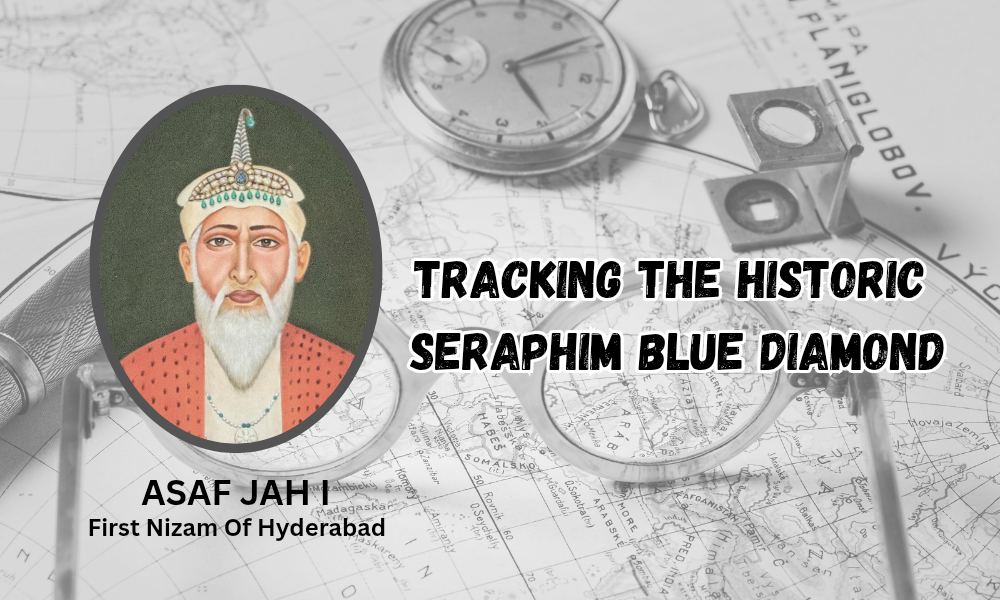
Mir Qamar-ud-Din Khan Siddiqi (1671–1748) founded the Asaf Jahi dynasty in 1724. As Asaf Jah I he became the first Nizam of Hyderabad in the year 1724. He was originally a noble in the Mughal Empire, serving under Emperor Aurangzeb. The Asaf Jahi dynasty ruled Hyderabad until 1948, when the princely state was annexed into independent India. The reign of the Nizams saw 7 Nizams ruling Hyderabad, through the decades.
The Nizams of Hyderabad not only ruled the Deccan region but also exercised control over the Golconda diamond mines and the diamond trade in the area. Much development occurred in Hyderabad and a significant funds, were spent on the welfare of the people. Revenue earned from the trade in Golconda diamonds, formed a sizeable portion of revenue for the Nizams.
The Golconda mines produced legendary gems such as the Koh-i-Noor, the Hope Diamond, the Seraphim Blue Diamond and the Darya-i-Noor. Recent interest in the Seraphim Blue Diamond, is understandable. Worn in a luxuriant turban ornament by Asaf Jah I, the blue diamond from the Golconda diamond mines has remained elusive for centuries. Keeping time in perspective, Asaf Jah 1 the first Nizam ruled Hyderabad in 1724.
The diamond left the treasury of the Nizams when, Asaf Jah II handed over the blue diamond to the French. The was not a sale or a gesture of good will, the Seraphim Blue Diamond was used to pay (fully or partially), for the military support that the French would provide to the Nizams. Separated from the turban ornament worn by the first Nizam, the 6 to 8 carat pear shaped, blue Golconda diamond, remained in private circles. It was clear that the French accepted the Seraphim Blue Diamond for its value, they gave no attention to the royal connection that it had.
Occasional rumors made a sporadic mention of the Seraphim Blue Diamond but, these attracted little attention. A spate of reports in recent times from different sources, narrated stories that were all surprisingly similar. Details about the pear shaped diamond with a high clarity and a fine blue color, began to attract attention. It was not long before, some reports mentioned that a group of diamond experts, had actually seen the Seraphim Blue Diamond in a Russian collection. Their observations seemed to confirm, information revealed in previous reports.
There has been no indication of a planned sale or auction of the Seraphim Blue Diamond. Collectors and big auction houses, would be glad to have a Golconda diamond auction. A blue diamond from the Golconda diamond mines, with a provenance that includes royalty and a history dating back to the 18th century – would make sensational auction news.
The cancellation of a highly touted Golconda diamond auction by Christie’s in 2025, disappointed diamond experts and collectors. The Golconda Blue Diamond was initially presumed to be the same as the Seraphim Blue Diamond. Quick clarifications made it possible to keep further rumors in check – in a very rare occurrence, Christie’s chose to cancel the widely publicized, Geneva auction for the Golconda Blue Diamond. This incident possibly explains the added interest that the Seraphim Blue Diamond has gained.
