

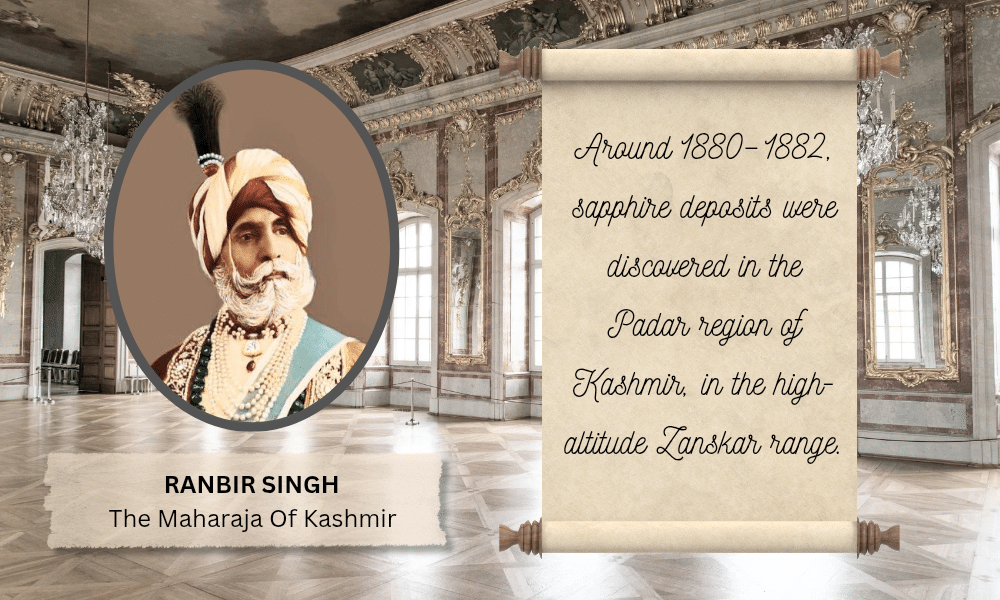
THE MAHARAJAS OF KASHMIR
The Dogra Dynasty and Kashmir sapphires are closely linked in history, both symbolizing the wealth and prestige of the Kashmir region. The Dogra Dynasty ruled Kashmir from 1846 –1947, and spanned 4 Maharajas. The first Maharaja Gulab Singh started the Dogra Dynasty after he purchased Kashmir from the British East India Company following the First Anglo-Sikh War.
The four Maharajas from the Dogra Dynasty included:
Maharaja Gulab Singh
Maharaja Ranbir Singh
Maharaja Pratap Singh
Maharaja Hari Singh
The Dogra Dynasty was noted for consolidating and expanding its territories, but also faced internal uprisings and external pressures. Maharaja Pratap Singh is known to have diverted significant funds to equip his army. His rule over Kashmir was often marred with financial difficulties.
THE SAPPHIRES OF KASHMIR
Among the greatest legacies of the Dogra period is the fame of Kashmir sapphires. It was around 1880–1882 when, sapphire deposits were discovered in the Padar region of Kashmir, in the high-altitude Zanskar range.
The sapphires mined during the first few years were undoubtedly of the highest quality. The first decade also saw some significantly large blue sapphires, emerge from the Kashmir mines. The beauty of Kashmir sapphires, set the gems apart from sapphires found elsewhere. The legendary quality of blue sapphires from Kashmir, were marked by a velvety cornflower blue with a soft, mesmerizing glow.
Kashmir sapphires quickly gained international fame and were sought after by European royalty, connoisseurs, and collectors. News that sapphire resources in the Kashmir mines were limited spread in elite circles. This resulted in a surge in value, demand and price of the Kashmir blue sapphire.
Sapphire mining was under the control of the Dogra rulers, who strictly regulated extraction. The increasing prices being paid for fine Kashmir blue sapphires, encouraged Maharaja Pratap Singh, to keep a reign on trade in the gemstone in Kashmir. By the early 20th century, however, the mines were largely exhausted, making authentic Kashmir sapphires extremely rare today.
THE MAHARAJAS AND SAPPHIRES
While the glory of Kashmir sapphires carries on to this day, extraction of sapphires from the mines in Kashmir, lasted for a limited time. Fine Kashmir sapphires, associated with the Dogra era, remain some of the most valuable gemstones in the world, often fetching record-breaking prices at international auctions.
That Dogra Maharajas of Kashmir leveraged Kashmir blue sapphires, to establish their identity and power base was never in doubt. There is another dimension to royal wealth that is portable – diamonds, gemstones and opulent jewelry. Erstwhile royals across the world often relied on their treasures—especially diamonds, sapphires, emeralds, rubies, and other prized gemstones—as a form of portable wealth. Gemstones and diamonds retained value across borders and could be sold or pawned discreetly when financial pressures arose.
The Zanskar Crown a spectacular 200+ carat Kashmir blue sapphire, offers a good example of how precious gems, came to the rescue of financially strained Kashmir Maharajas. The fine cushion cut blue sapphire, was sold by Maharaja Pratap Singh of Kashmir to a European collector – to settle financial debts. The sapphire has been referred to as the Zanskar Blue, by some gemstone collectors. Irrespective of the name it does seem that, there was just one big cushion cut Kashmir sapphire, that was sold from the treasury of the Maharajas.
